
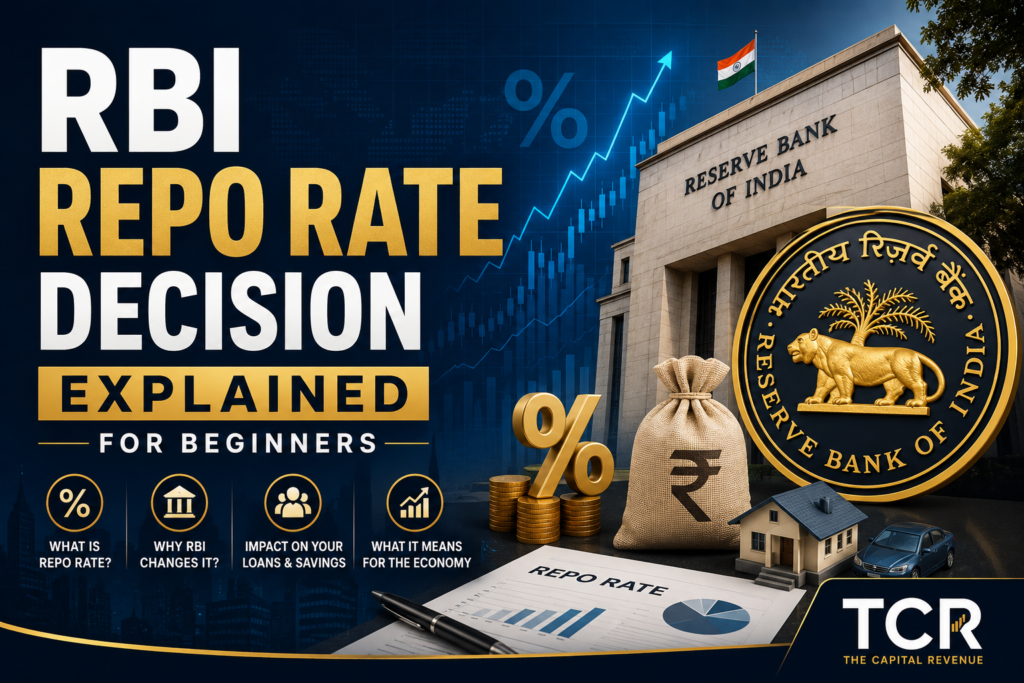
You’ve probably seen headlines saying “RBI keeps repo rate unchanged” and wondered why a number set by some committee in Mumbai should matter to you. Here’s the short answer: it quietly decides how expensive your home loan, car loan, and even your fixed deposit returns are going to be. Let’s break it down. RBI Repo Rate Decision Explained for Beginners.
Table of Contents
ToggleWhat Just Happened
In its June 2026 policy review, the Reserve Bank of India’s Monetary Policy Committee (MPC) decided to hold the repo rate steady at 5.25%, maintaining the “neutral” stance it has held for a few meetings now. The committee, headed by RBI Governor Sanjay Malhotra, met from June 3-5 and reached this decision unanimously. Alongside the repo rate, two related rates were also left untouched — the Standing Deposit Facility (SDF) rate at 5%, and the Marginal Standing Facility (MSF) rate at 5.5%.
In plain English: nothing changed, and the RBI signaled it isn’t in a hurry to change anything soon either.
What Is the Repo Rate, Actually?
Think of the repo rate as the interest rate the RBI charges when commercial banks (like HDFC, SBI, or ICICI) borrow money from it for the short term. It’s the RBI’s primary tool to control how much money is flowing through the economy.
Here’s the chain reaction:
Repo rate goes up → banks pay more to borrow from RBI → banks charge you more on loans → your EMIs go up, but your FD returns may improve
Repo rate goes down → borrowing gets cheaper for banks → loan interest rates fall → your EMIs may shrink, but FD returns often dip too
Repo rate stays flat (like this time) → no major shift either way — stability for now
Why Does the RBI Care About This Number?
he RBI’s job is to balance two things that often pull in opposite directions: controlling inflation and supporting economic growth. Raising the repo rate cools down an overheating economy by making borrowing expensive (people spend less). Cutting it does the opposite — it encourages borrowing and spending to boost a slowing economy.
This time, the RBI chose to hold steady because of a mix of factors: inflation is running below the target range but with an upward bias (meaning it could tick up), while elevated global energy prices are adding pressure on both growth and prices. Governor Malhotra noted that global conditions remain uncertain, and the committee preferred to wait and watch rather than make a move in either direction.
What This Means For You
If you have a floating-rate home loan: Your EMI will likely stay the same for now. Banks usually adjust floating rates in line with repo rate changes, and since there’s no change, there’s nothing for your bank to pass on.
If you’re planning to take a loan soon: This is a reasonably stable window. Rates aren’t expected to spike in the immediate term, though that can shift depending on how inflation and global oil prices move over the next couple of months.
If you have a Fixed Deposit: FD rates tend to track the repo rate fairly closely. With no change this time, expect your bank’s FD rates to stay roughly where they are — no sudden jump, no sudden drop.
If you invest in stocks: Markets had largely priced in this “no change” outcome already, since it matched what most analysts expected. The bigger story for investors is usually the RBI’s commentary on inflation and growth outlook (which can hint at future rate moves) rather than the rate decision itself.
When’s the Next Decision?
The RBI’s MPC meets roughly every two months to review the rate. The next meeting is scheduled for August 3-5, 2026. Until then, keep an eye on inflation data and global crude oil prices — these are the two factors most likely to influence whether the RBI moves at the next meeting.
The Takeaway
The repo rate might sound like a technical banking term, but it’s really just the RBI’s way of nudging the entire economy faster or slower. When it stays flat, like this time, it usually means the RBI is comfortable with where things stand — not too hot, not too cold — and is choosing patience over action.
This article is for informational and educational purposes only and should not be considered financial advice. Please consult a registered financial advisor before making investment or borrowing decisions.

